
Commercial Curtains & Blinds
Best Curtains for Airbnbs in Kenya

Choose curtains that welcome guests and work reliably between bookings. This host-focused guide covers bedrooms, shared spaces, maintenance, hardware and budgeting.
Curtains in an Airbnb have more work to do than curtains in a styled photograph. Guests need privacy, a comfortable level of light and an obvious way to open and close them. Hosts need materials that can be cared for consistently, hardware that works reliably and a room that still looks welcoming after repeated changeovers.
The best curtains for Airbnbs in Kenya therefore balance appearance with the practical demands of short stays. A coastal apartment, a city studio and a larger holiday home may need different solutions. This guide helps you prepare a room-by-room brief, compare fabrics and avoid spending on features that do not improve the guest experience.
Start with guest needs rather than a colour theme
Imagine arriving at the property for the first time. Can you immediately find and operate the curtains? Do they close across the entire window? Is a bedroom exposed to a neighbouring walkway? Does a balcony curtain block access when open? These everyday questions are a useful starting point for a hosting specification.
Prioritise the problems that guests cannot easily solve themselves. An unsuitable cushion can be moved, but a curtain that does not cover the window remains a privacy problem throughout the stay. A complicated opening arrangement may cause frustration or encourage guests to pull on the fabric in a way the hardware was not designed to tolerate.
Make a short brief for every room, describing its function, outside lighting, privacy requirement and existing fittings. Use the curtain collection to identify styles only after these requirements are clear. Function and appearance can then be selected together rather than corrected separately.
Bedroom curtains: coverage comes first

A guest bedroom generally needs a substantial privacy layer. Consider the direction of morning light and any exterior lighting that remains on at night. Choose the fabric and installation according to the level of light reduction you intend to provide, and confirm the particular product's specification rather than relying on a dark colour.
The blackout curtain guide explains why fabric performance and fitting must work together. Gaps at the top, sides, bottom or centre can remain bright even with a light-blocking fabric. Ask the maker and installer to consider those gaps before the curtains are produced.
Do not describe a room as fully blackout simply because the product has blackout in its name. Check the completed room under realistic conditions. Use accurate listing descriptions that reflect the guest experience, without making promises about sleep, health outcomes or a level of darkness you have not established.
Add sheers for a useful daytime setting
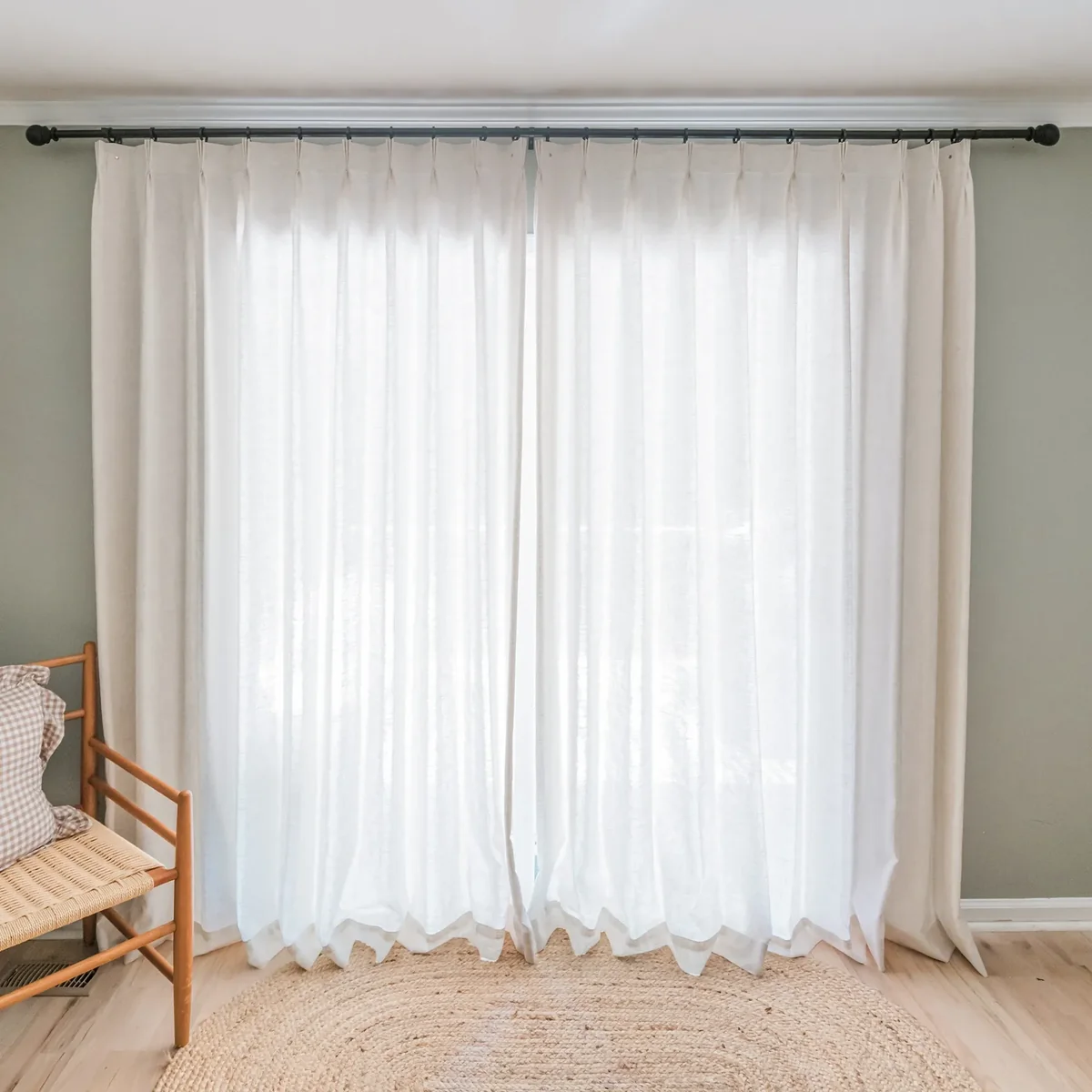
A separate sheer can allow guests to keep a softer daylight layer across the window while opening the main curtain. This can be helpful in bedrooms, living rooms and dining areas where uncovered glass feels exposed. The two layers should operate independently so guests have a simple choice of settings.
Sheers should not be treated as a dependable night-time privacy barrier. When the room is brighter than outdoors, silhouettes or interior details may be visible. A suitable main curtain remains important where privacy is required. Explain the arrangement clearly if it is not immediately obvious.
Read the sheer curtain guide before choosing a fabric. Check its transparency, care requirements and compatibility with the front layer. A layered window treatment should feel easy to use rather than like two unrelated fabrics competing for the same space.
Living and dining areas need flexibility
Shared spaces may need filtered daylight for daytime use and stronger privacy after dark. A room with a television may also need a way to reduce glare at certain hours. Plan around the actual position of the seating and screens instead of assuming that the bedroom fabric should be repeated everywhere.
An attractive neutral or textured main curtain can support the room's overall style without overwhelming furniture and artwork. A stronger accent colour can work where the rest of the scheme is restrained. Test samples with the existing surfaces so the choice remains coherent in daylight and under the usual evening lighting.
The living-room curtain guide provides more detailed design considerations. For a holiday property, give equal attention to how the curtains behave when open: guests should be able to enjoy the daylight and view without a bulky stack obstructing the opening.
Balcony doors and frequently used openings
Curtains across a balcony door need sufficient travel and a sensible place to stack. If guests must push through hanging fabric to reach the door, the arrangement may be inconvenient and place unnecessary strain on the curtain. Consider the door swing, handle and normal route through the room.
Avoid a drop that creates an obvious obstruction in a busy walkway. A decorative pooling finish may photograph well but require more attention in daily use. Confirm the desired clearance with the maker, measuring from the correct hanging point and checking whether the floor level varies across the opening.
The hardware should allow smooth operation. A panel that catches at a joint or support is not made more guest-friendly by adding a small instruction card. Address the physical problem first. Use concise operating instructions only where they genuinely help with an otherwise suitable system.
Choose fabrics for realistic care
Before ordering, ask how each fabric should be cleaned and dried. A textile that needs a specialist process may still be suitable, but that requirement should fit your housekeeping plan. Do not assume every fabric that looks synthetic can be machine washed, or that a lined curtain has the same care needs as its face fabric alone.
Think about who removes, cleans and rehangs the curtains. Large or heavy panels may need more careful handling. Coatings, linings, decorative trims and embroidery can affect the approved method. Keep the manufacturer's care information accessible to the people responsible for changeovers and periodic maintenance.
Choose a practical finish for the way the property operates, not a claimed universal hospitality fabric. If a particular stain resistance or other performance matters, request evidence for the actual product. Avoid describing an ordinary curtain as antimicrobial, fire-retardant or otherwise certified without appropriate documentation.
Coordinate the palette without making every room identical
A consistent palette can connect the property while allowing individual rooms to have character. Repeat a small number of colours or textures across rooms rather than adding an unrelated curtain design at every window. This can also simplify future matching discussions, although later fabric batches may still vary.
Take account of fixed surfaces, including flooring, walls and larger furniture. Samples should be viewed in the property rather than only against a showroom background. White, cream, grey and beige all have undertones, and a nearly matching fabric can look less deliberate than a clearly complementary shade.
The Diani Airbnb curtain furnishing project illustrates a coordinated scheme using neutral, rust and burgundy finishes. Use it as inspiration for the planning approach, not as a promise that the same materials, cost or result will suit every property.
Select hardware that guests can use easily
A curtain support system should match the heading, fabric weight and opening width. Eyelets require a suitable rod; hooked headings require appropriate rings or gliders. If the property has both sheers and main curtains, specify a double rod or separate tracks that allow independent movement.
Compare the options in Curtain Rails vs Curtain Rods. The decorative finish matters, but smooth movement and secure fixing are essential. Existing hardware should be assessed before it is asked to carry a heavier curtain or an additional layer.
Follow the product's safety instructions for any cords, chains or other operating components. Avoid accessible loose loops, especially in properties where children may stay. Where the arrangement or fixing condition is uncertain, have a competent installer assess it rather than improvising a solution between guest arrivals.
Create a window schedule before requesting quotes
Give every opening a simple identifier, such as Bedroom 1 Window A or Living Room Balcony Door. Record the room, approximate span, intended drop, number of layers, preferred heading and any existing hardware. Add photographs that show the entire opening and surrounding walls, not only the glass.
This schedule helps prevent similar-looking windows being confused during production or installation. It also makes it easier to compare quotations and later identify a replacement panel. Do not assume every bedroom window in the property has the same dimensions merely because the frames look alike.
Agree who will take and approve final measurements. Approximate host measurements can support an initial discussion, but made-to-measure production needs the correct specification. Where access, shape or height makes measuring difficult, request professional assessment rather than placing an order from a guess.
Budget for the completed installation
Include main curtains, sheers, any lining, stitching, rods or tracks, accessories, fitting and delivery. A product-listing price may cover only a specified item, not the entire window treatment. The curtain pricing guide explains the distinctions to clarify before comparing amounts.
If the budget is limited, prioritise privacy and reliable operation in guest sleeping spaces. Then decide where an additional layer or decorative upgrade gives useful value. Ask for alternative specifications based on the same measurements so you can see the effect of each change rather than comparing different project scopes.
Do not assume curtains will produce a particular increase in nightly rates, occupancy or review scores. They are one part of the guest experience. Choose them to solve identifiable room problems and support the property's style, without treating an unsupported financial return as part of the quotation.
Plan installation around bookings
Confirm the scope and timing directly before scheduling work close to a guest arrival. Allow time to inspect the installation and resolve any fit or movement issues. An estimated production period should not be presented to guests as a guaranteed completion date until the supplier has confirmed the actual arrangement.
Clarify access, old-hardware removal, measuring, fitting and cleanup responsibilities. The installer may need to assess the wall or ceiling and choose suitable fixings. In managed buildings or rented properties, confirm any necessary permission before changing mounting points.
After fitting, check each curtain from the guest's normal position. Close it fully, open it fully and check door clearance. Evaluate bedroom light gaps and privacy under relevant conditions. This is a more useful handover than looking only at the curtains while they are neatly tied back.
Build a simple housekeeping check
Check that every panel opens and closes without excessive force.
Look for loose supports, damaged hooks or missing gliders.
Confirm that the main curtains close across the opening.
Check for stains, snags and fabric caught on handles.
Keep cleaning instructions and panel locations recorded.
Report faults before they become a recurring guest problem.
Cleaning frequency should follow the actual condition of the curtains, occupancy and the fabric guidance rather than a universal timetable. Record any repairs or replacements so the next housekeeper knows what has changed. A small maintenance record can prevent repeated improvisation and preserve a consistent room presentation.
Photograph the finished rooms honestly
Arrange the curtains neatly for listing photographs, but show a room guests can realistically use. Avoid presenting a lighting condition that conceals a known privacy or coverage problem. Photographs should communicate the room's atmosphere without substituting styling for a functional window treatment.
Keep spare component references and the approved fabric details for future enquiries. If you need an exact match later, confirm availability rather than assuming a fabric will remain unchanged indefinitely. For multi-room properties, discuss that risk while selecting the initial scheme.
Prepare your Airbnb furnishing enquiry
Contact Curtains Kenya with the property location, room schedule, photographs, approximate dimensions and your preferred completion window. Explain which bedrooms need stronger light reduction, where sheers are wanted and which existing fittings you hope to retain. Share the desired palette and practical cleaning constraints.
Use the contact page to request a tailored quotation. A successful Airbnb curtain scheme is welcoming, easy to operate and maintainable over time. Good planning brings those qualities together without relying on unnecessary extras or promises that a curtain alone cannot deliver.
Helpful answers
Frequently asked questions
What curtains are best for an Airbnb bedroom?
Prioritise an appropriate opaque or light-reducing main curtain, sufficient coverage and easy operation. Add a separate sheer when you want filtered daylight. Test the actual room before describing it as blackout.
Are sheers enough for Airbnb privacy?
Usually not where night-time privacy is required. Interior lights can make the room visible through a sheer after dark. Provide a suitable main curtain or other opaque covering.
Should every room have matching curtains?
A coordinated palette is useful, but identical fabrics are not essential. Bedrooms and shared spaces may need different light control. Keep the overall scheme consistent while specifying each room for its purpose.
How can a host make curtain maintenance easier?
Choose products with clear, practical care instructions, record the fabric reference and panel locations, and inspect movement and fixings between stays. Cleaning frequency should follow actual use and the product guidance.
Can curtains guarantee better Airbnb ratings?
No. Suitable curtains can address practical guest needs, but ratings and bookings depend on many factors. Do not promise occupancy, income or review improvements from curtains alone.
What information is needed for an Airbnb curtain quote?
Provide the room and window schedule, photographs, approximate dimensions, preferred layers, existing hardware, installation location and target completion date. Confirm final measurements before production.