Curtains by Room
Shower Curtains in Kenya: Standard and Extra-Long Buying Guide
A shower curtain needs to suit the opening and manage water in the intended bathing area. Compare dimensions, material, liner requirements and care before buying.
Shower curtains in Kenya should be selected by the bathing-area layout, not just by colour or a familiar size label. The curtain must suit the opening, attach to the available support and sit at an appropriate length for the way water is contained. An attractive curtain that is too short or too narrow may leave the practical problem unresolved.
This guide covers both standard and extra-long shower curtain enquiries. It explains the measurements to prepare, the distinction between a decorative curtain and a liner, and the questions to ask about care and fittings. Contact Curtains Kenya with your dimensions to confirm available options; this guide does not imply that every material or extra-long size is currently stocked.
Identify the bathing arrangement before measuring
Start by describing whether the curtain is for a bath with a shower, a shower tray, an alcove or another arrangement. Take a photograph showing the support, opening and lower area where the curtain will finish. These details matter because the correct position is related to the way the space contains water, not simply the height of the ceiling.
Note any door, shelf, tap or screen that could interfere with movement. Check whether the curtain is meant to close across one straight span or follow a shaped support. A description such as standard bathroom curtain leaves too much uncertain when the opening or support is unusual.
Measure the width of the actual opening
Record the span the curtain needs to cover, using a consistent unit. Explain whether the support is straight or curved and whether the quoted measurement follows the support path. Ask how the selected curtain’s finished width relates to coverage, gathering and overlap for that arrangement. Do not assume a flat sheet equal to the opening width gives the intended result.
If two panels are proposed, confirm the width of each and how they meet. Record whether the product is supplied as one curtain or a set. This avoids comparing prices for different quantities. Keep a labelled sketch with the measurements so that a remote supplier can understand the opening you are describing.
Measure drop from the correct attachment point
The curtain’s finished length must be compared with the point from which it actually hangs. Hooks, rings or another attachment can affect that relationship. Measure from the agreed reference point and identify the intended lower edge for your particular bath or shower. Do not copy a ceiling-to-floor measurement into an order without clarifying the fitting.
Ask the supplier or installer to confirm the suitable lower-edge position for the layout. The curtain should work with the intended water-containment area without unwanted dragging or obstruction. Avoid assuming a universal clearance applies to all bathrooms. The purpose of the measurement is a workable fitted arrangement, not merely choosing the longest available option.
Understand what extra-long means
Extra-long is a relative description, so request exact dimensions. A longer drop can be relevant when the support is mounted higher or the required coverage differs from a standard set, but length alone does not establish suitability. Check the width, heading, attachment spacing and material at the same time.
When comparing a standard and a longer option, ask whether both have the same construction and intended use. A decorative long curtain may require a separate water-facing liner. Do not assume that extending ordinary window-curtain fabric creates a suitable shower barrier. Confirm the available product or making arrangement before approving a custom length.
Separate the curtain from the liner
A decorative outer curtain and a liner can perform different roles. Some shower curtains are designed to act as the water-facing layer themselves; others are intended to be used with a separate liner. Ask which arrangement applies to the exact product. The answer should come from its instructions and specification rather than a guess based on the photograph.
If two layers are used, check their dimensions and how they attach. Confirm whether the quoted price includes both or only one. Plan how each layer will be removed and cleaned. A complete order should describe the visible curtain, liner and fittings separately where applicable so that nothing essential is left implicit.
Compare materials using product instructions
Shower curtains may use different plastic or textile constructions, and their care requirements are not interchangeable. For example, IKEA lists a polyethylene product and a separate textile product with a water-resistant surface; these are examples of different constructions, not a claim about Curtains Kenya stock. See the manufacturer’s plastic curtain page and textile curtain page.
For any option you are considering, ask about intended use, surface treatment and the permitted cleaning method. Do not equate a fibre name with a guaranteed level of water resistance. Retain the information for the actual product supplied, since instructions for another curtain may not apply.
Check the support and attachment components
Identify the existing rod or rail and the hooks or rings it uses. Confirm the curtain’s attachment arrangement and whether compatible components are included. A new curtain may not be ready to hang if the product relies on fittings you do not already have. Check how smoothly it can move across the support.
If the support is loose, damaged or unsuitable for the proposed layers, arrange appropriate assessment. Do not assume a support intended for one lightweight curtain can carry a different arrangement without checking. The general fitting guide explains why hardware should be considered as part of the complete order, though shower-specific suitability must be confirmed separately.
Choose colour without losing track of function
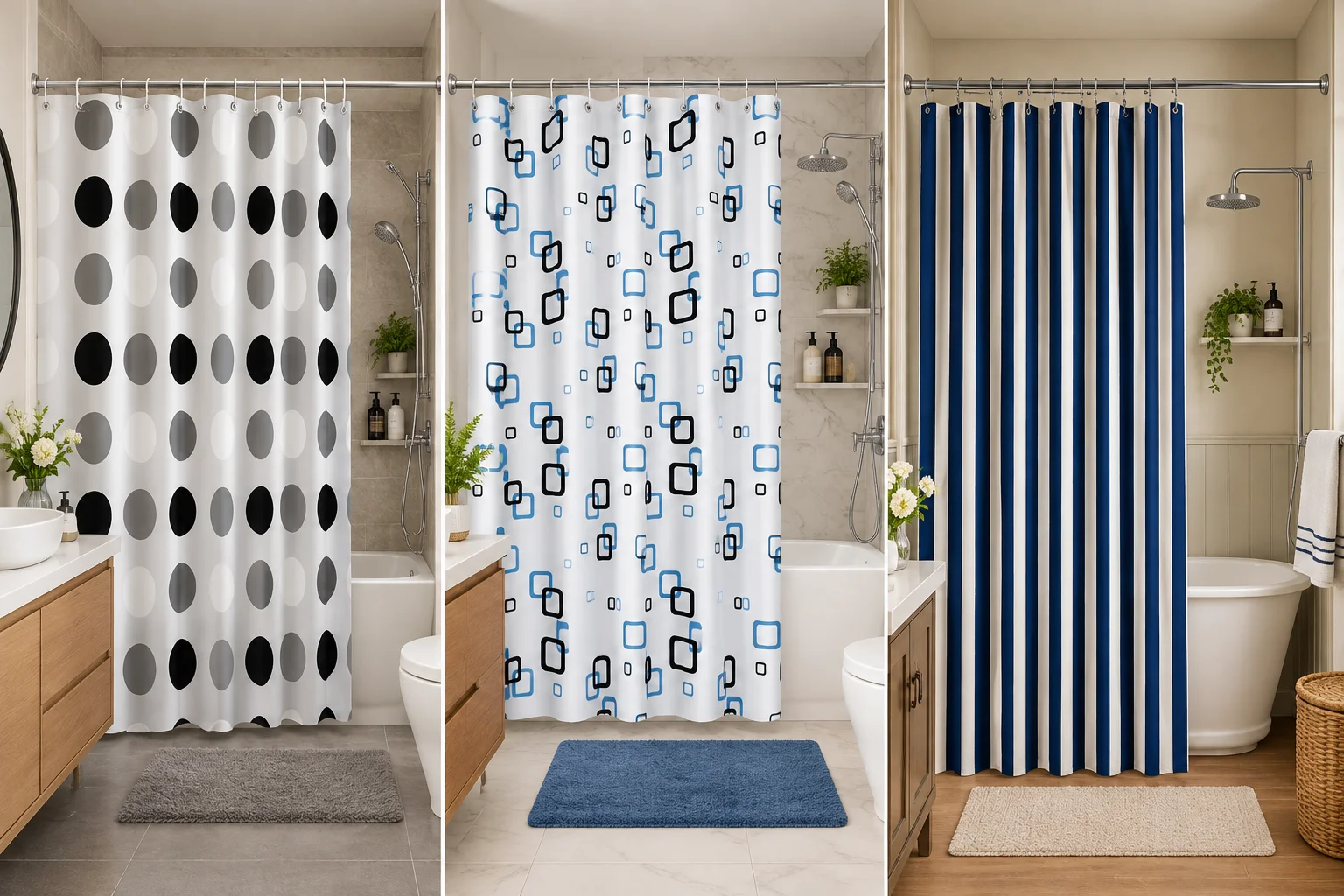
Compare the curtain with the bathroom’s tiles, floor and larger fittings. A plain colour can simplify a busy tiled room, while a pattern can provide a focal point in a quieter scheme. Consider how much of the curtain is visible when open and closed. A small product photograph may not show the scale of a pattern clearly.
The neutral colour guide can help with a beige or white palette, but material suitability for the wet area remains a separate question. Do not substitute an ordinary decorative window curtain merely because its colour is ideal. The selected product should meet both the appearance preference and the intended shower use.
Plan cleaning before purchase
Request instructions for washing or wiping, permitted cleaning products and drying. Follow the specific label rather than a universal internet recipe. Do not assume that every textile curtain can be machine washed or that every plastic curtain can tolerate the same cleaner. Any liner may have instructions different from the decorative outer layer.
Think about access for removing and rehanging the curtain and how it will dry after use. Keep the fabric from remaining tightly bunched where the product’s guidance calls for it to be spread out. If the finish or material changes during use, consult the supplier about appropriate care or replacement rather than applying an unapproved treatment.
Consider shared and frequently used bathrooms
For a bathroom used by several people or guests, choose an arrangement whose operation and care can be explained simply. Confirm that the curtain moves easily and that the intended closed position is obvious. A complicated layered system may create extra work if people repeatedly leave it in the wrong position.
Keep a short record of the product reference, dimensions and care instructions for whoever manages cleaning. If you need replacement pieces later, those details are more useful than an old photograph alone. Confirm replacement availability at the time rather than assuming the same design or dimensions will always remain stocked.
Compare prices for complete usable sets
When reviewing prices, list the curtain, liner, hooks or rings and any required support separately. Add delivery and fitting work where applicable. Two similar-looking prices may describe different quantities or only part of the arrangement. Ask what is included before deciding which option is more affordable.
The general curtain price guide explains the principle of comparing complete specifications. Its window-curtain examples should not be treated as shower curtain prices. Request a current quotation for the exact shower product, dimensions and accessories you need, especially when asking about an extra-long option.
Check a custom or altered option carefully
If the available dimensions do not fit, ask whether the selected product can be altered or whether another suitable option can be obtained. Do not assume that cutting or adding length will preserve the intended construction or water-facing function. The attachment area, seams and lower finish may all need consideration.
Before approving any work, agree the finished width and drop, reference points and care instructions. Confirm the price of the alteration and whether the result meets the intended use. A custom arrangement should be described clearly enough that you can compare the supplied product with the agreed record when it arrives.
Inspect the order before use
Check the quantity, dimensions, material description and attachment arrangement against the order. Identify any included liner and accessories. Keep packaging labels and care information while you make these checks. If something differs from the specification, raise it with the supplier before cutting, altering or discarding information needed to identify the product.
After hanging, review movement and the intended coverage before relying on the arrangement during normal use. Address any practical gap or obstruction with the supplier or installer. A shower curtain is one part of the bathroom layout, so an unsuitable support or containment arrangement should not be treated as a fabric problem alone.
Prepare an extra-long shower curtain enquiry
Send a labelled sketch showing the opening width, support position and required drop, together with photographs of the bath or shower area. State whether you want a decorative curtain, a water-facing layer or both. Include preferred colours and ask the team to confirm suitable available constructions rather than requesting extra-long without a measurement.
Contact Curtains Kenya for current options and pricing. Confirm Nairobi store directions and hours if you want to discuss the order in person. For other cities and towns, delivery can be arranged using the customer’s preferred courier service, with charges and dispatch details agreed for the order. Confirm any installation requirement separately.
A simple size-check example
Imagine that a bathroom has a higher-than-usual curtain support and a standard curtain appears too short. The next step is not simply to order the longest product available. Record the actual attachment point, the intended lower edge and the width required along the support. Then compare both dimensions with the proposed replacement and ask whether its construction suits the water-facing role.
If a separate liner is needed, check that it also has suitable dimensions and compatible attachments. This example is a measuring process, not a recommendation for a particular clearance or stocked size. It helps prevent a longer decorative layer from being purchased while the functional liner or fitting problem remains unresolved.
Helpful answers
Frequently asked questions
How do I choose the right shower curtain size?
Measure the opening and the drop from the actual hook or ring position to the intended lower edge. Account for the way the curtain will gather and overlap. Confirm the product’s finished dimensions and the appropriate lower-edge position for your bath or shower layout before ordering.
What is an extra-long shower curtain?
It is a curtain with a longer drop than the standard option being compared. There is no useful single size to assume from the phrase alone. Ask for the exact width and length and check them against your fitting and bathing-area measurements.
Does every shower curtain need a liner?
No universal rule applies to every product. Some are designed as the water-facing barrier, while others require a separate liner. Check the manufacturer’s intended use and instructions for the specific material rather than deciding from its appearance or fibre name alone.
Can shower curtains be machine washed?
Only if the product instructions permit it. Plastic and textile curtains can have different care requirements, and finishes may impose additional restrictions. Check washing, drying and cleaning-product guidance before buying, and retain the instructions for the selected curtain and liner.
Can Curtains Kenya provide long shower curtains?
Contact the team with the exact width and drop you need to confirm current options or whether a suitable longer arrangement can be sourced. Do not assume an extra-long size is in stock. Confirm material, price, fittings and delivery details before ordering.